 Shoppex
Fraud Shield.
Ban Radar.
Chargeback Shield.
Fraud Shield checks buyers before they pay, Chargeback Shield answers disputes with proof from your own orders, and Ban Radar watches your dispute rate.


Sixteen ways to refuse an order.
Fraud Shield scores orders for risk from 0 to 100 and blocks repeated failed payments out of the box. The rest is yours to switch on: a risk ceiling per product, and a blocklist that reaches the network, the device and the card.
Email, domain, disposable email, Discord ID, IP address, IP range, country, city, ISP, ASN, VPN, Tor, hosting, user agent, device fingerprint and card fingerprint.
- Allowlist first
Allow a trusted buyer by email, IP, IP range or device, and they pass every block.
- Auto block
Pick a failed-payment count and a window in minutes. Fraud Shield then blocks the email, IP and device behind them.
- Check a buyer
Paste an email, IP or device and see whether a blocklist rule or a risk signal would stop them, without blocking anyone.


Chargebacks run on a deadline. Chargeback Shield gets there first.
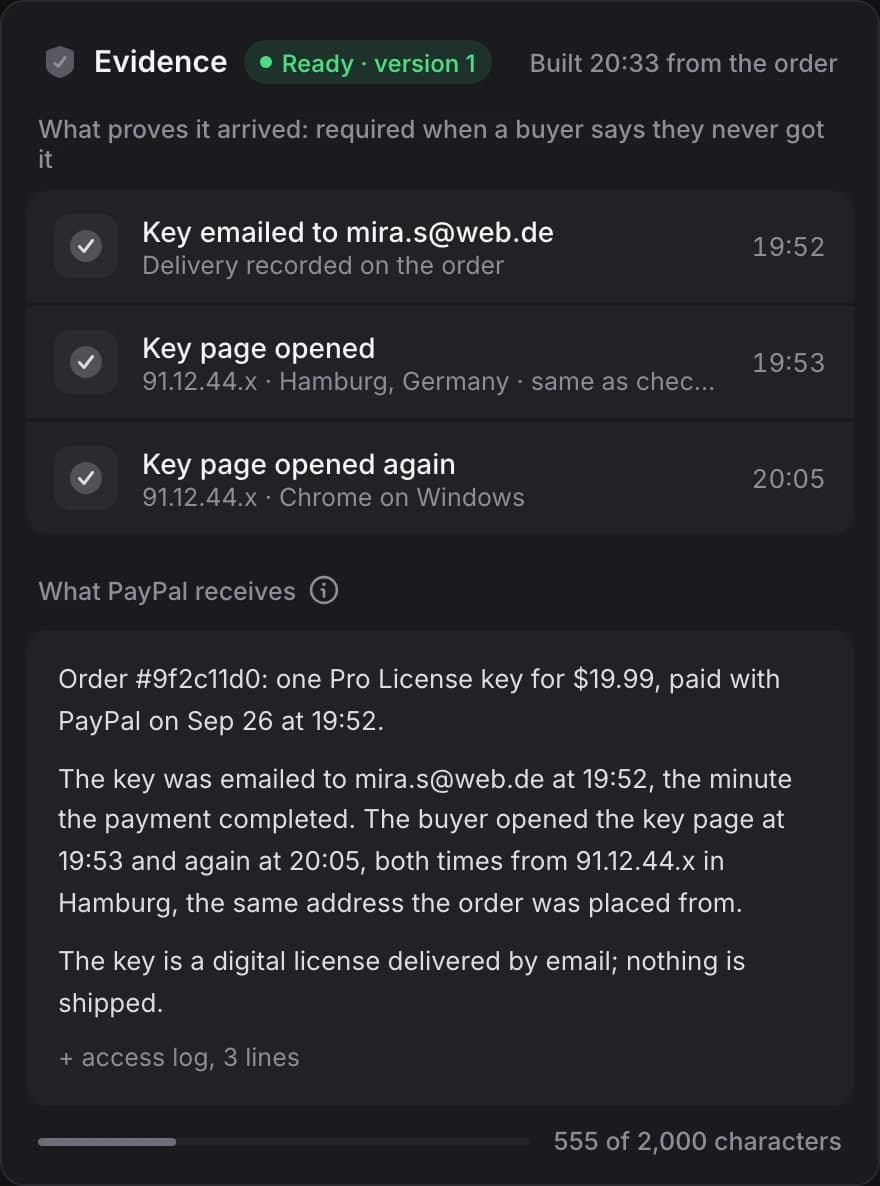
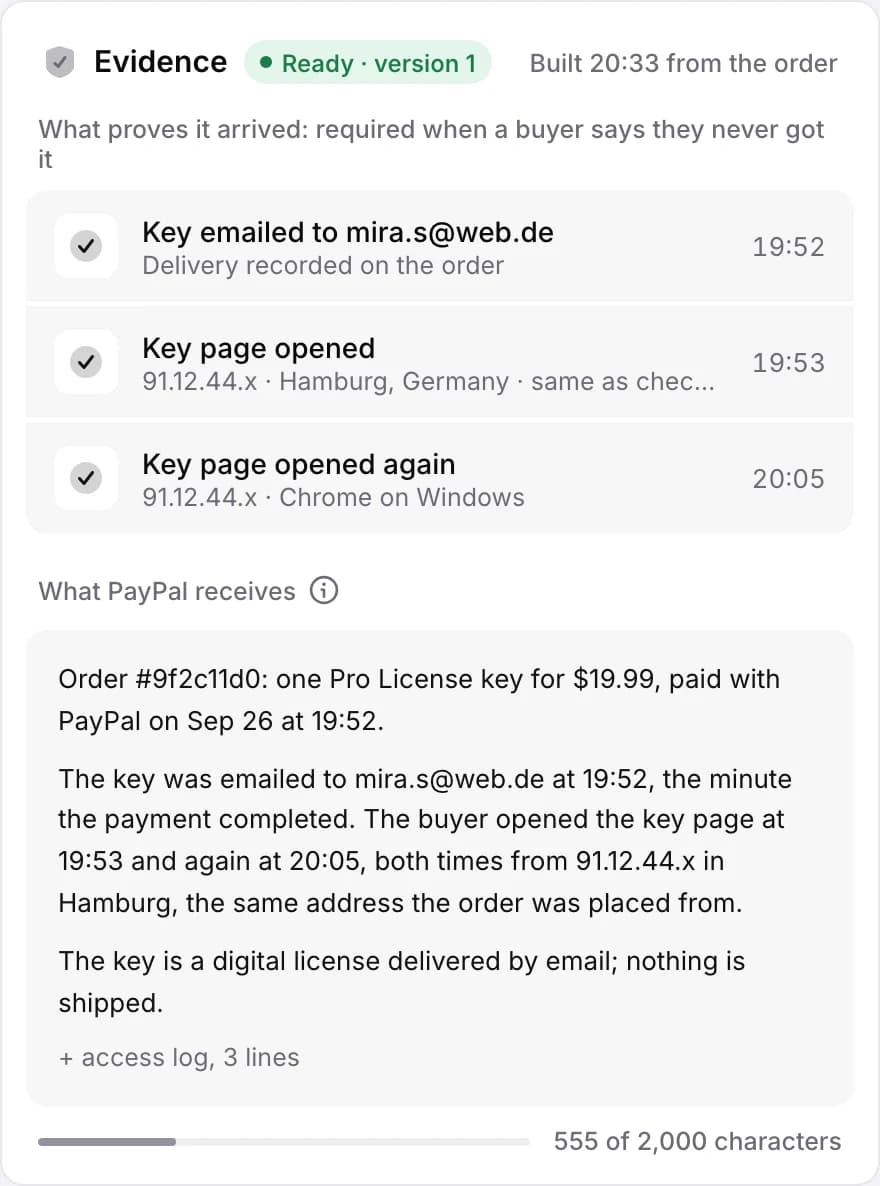
When Stripe or PayPal opens a dispute, Chargeback Shield builds the file from your own order data: the delivery, what the buyer opened afterwards and the IP it came from.
- It answers for you
Automatic by default. Turn it off to approve each case yourself. If you forget, a complete file still goes out 24 hours before the deadline.
- Small ones can go
Set a limit and Chargeback Shield accepts the disputes under it instead of fighting them. Off until you set one.
- Fraud warnings first
When a buyer's bank flags a Stripe payment as fraud, it can refund on the spot, up to a cap you set. Off by default.
Watch your dispute rate every day.
Ban Radar checks your Stripe and PayPal dispute rates daily. Once an account has 100 settled payments in 90 days, it warns you at 0.4%, calls 0.75% high risk and can tighten checkout for you.


- It ships watchingMonitoring is on. Automatic protection and checkout protection are off until you turn them on.
- Step-up and BlockStep-up asks Stripe card buyers for 3D Secure and refuses VPN, proxy and high-risk connections. Block adds a limit on repeat orders.
- Crypto is never checkedStep-up and Block do not apply to crypto payments.
Know who is signed in.
Sign in with a passkey, or back your password with an authenticator code, see every device that is signed in, and sign the others out.
- Passkeys and two-factor
Sign in with your fingerprint, face or device PIN. Two-factor adds an authenticator code to password and social sign-ins, with backup codes.
- A new sign-in emails you
When your account signs in from an address it has not seen. After ten known addresses it pauses the alerts and says so.
- API keys on a short list
Limit a Developer API key to the addresses you list. Anything else is refused.


What Shoppex never holds.
Three things that stay with you or your payment provider.
- Your buyers' card numbers
Card and equivalent payment credentials are handled by your payment providers. Shoppex does not store them.
- Your wallet keys
The Shoppex Wallet's spending seed is encrypted on your device. Shoppex keeps only that encrypted backup, so it cannot decrypt it and cannot move your coins.
- Your sale proceeds
Buyers pay your own Stripe, PayPal or wallet. There is no payout step, because Shoppex holds no sale proceeds.
Security questions.
Does Fraud Shield block buyers by default?
Only after repeated failed payments, which the auto block stops out of the box. The rest is yours to switch on: a risk ceiling per product (it ships at 100, which is off), the blocklist, and the VPN and Tor switches. An allowlist match passes every block.
Does Chargeback Shield win every dispute?
No, and nobody can promise that. It builds the file from your order data and sends it before the deadline. The bank or PayPal decides.
What happens when proof is missing?
When a buyer says they never got the product, Chargeback Shield needs a verified delivery event. Without one, the case waits for you and says what is missing.
Does Ban Radar change my checkout on its own?
Not until you let it. It ships watching your dispute rate, with automatic protection off and checkout protection off.
Your Stripe and PayPal dispute rates in one place.
Ban Radar is on by default and checks each one every day. Open Fraud in your dashboard to see them.